

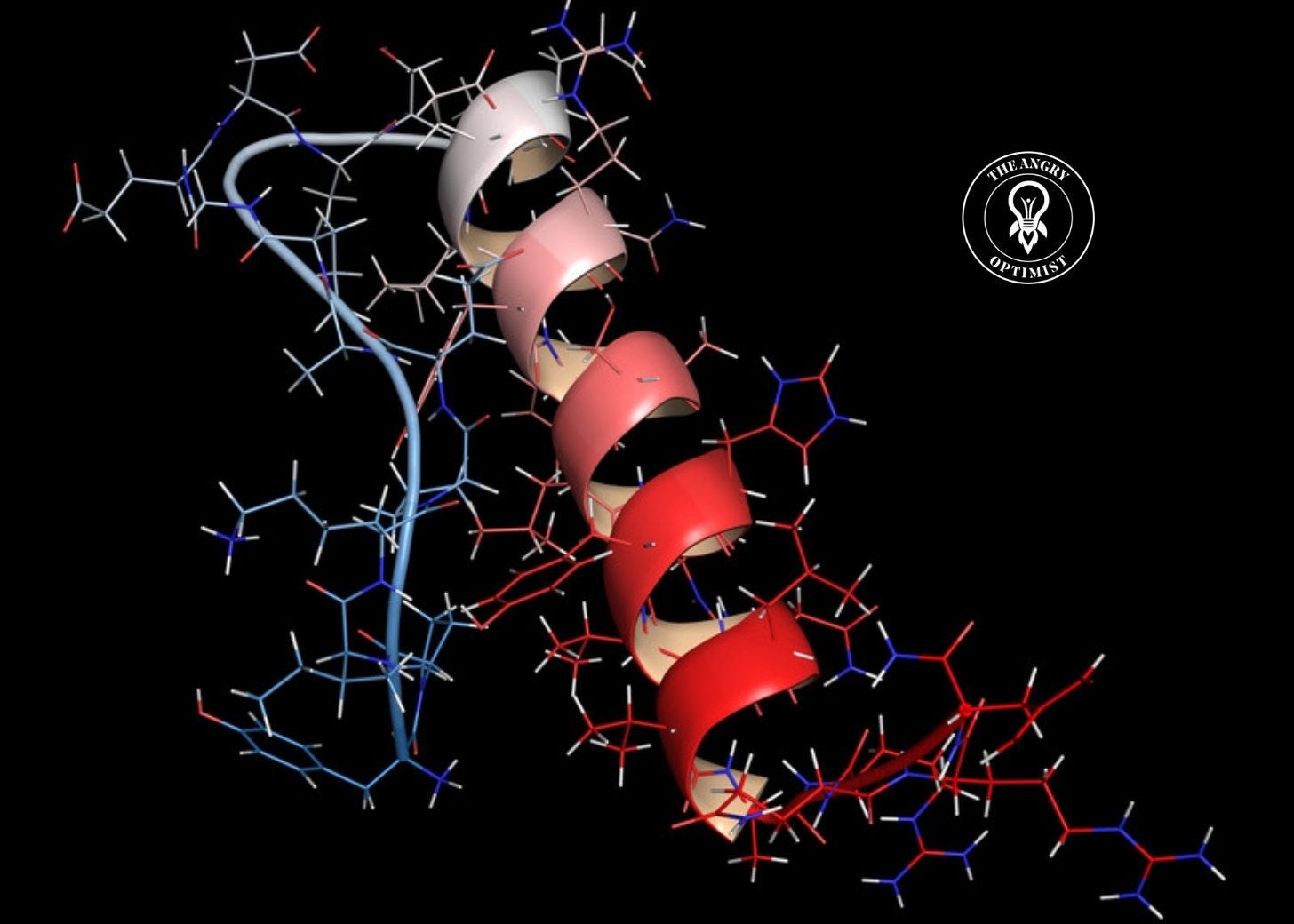
Marked and unmarked proteins bound just as strongly to three different targets, including part of the spike protein on the virus behind COVID-19.
With the watermark, DNA manufacturers can approve orders from known AI systems faster and spend their time on suspicious sequences.
According to DeepMind, this is the first time watermarked proteins have been shown to work biologically.
Google DeepMind has developed a method that puts an invisible watermark in proteins designed by AI. The marked proteins work just as well as proteins without a mark. The method is called SynthID Bio and is described in a study in Nature. The researchers describe it as a proof of concept.
With the mark, it is possible to show that a gene sequence comes from a known AI system. Trusted designs can then pass through biosecurity screening faster.
A pattern in the choice of amino acids
Proteins are chains of amino acids. When an AI tool designs a protein, it picks the amino acids one at a time. SynthID Bio nudges those choices slightly using a key. Each individual choice looks normal. Together the choices form a statistical pattern that a detector can recognize. The mark is not added afterward. It appears as the protein is created.
The researchers built the method into ProteinMPNN, a design tool from the Baker Lab. In a separate step, they filtered out proposals that would not become a working protein. SynthID Bio builds on SynthID, Google's system for recognizing AI-generated content.
DeepMind has also modified a small part of AlphaFold 3, which predicts the three-dimensional shape of proteins. AI tools like these can predict the shape and function of proteins in minutes instead of years. The mark sits in the model's weights and carries over into the structures it predicts. The modified version keeps its accuracy. The detector found the mark in more than 99.8 percent of the marked structures, when it was allowed to wrongly flag at most one in a thousand unmarked structures.
Just as good in the lab
AI-designed proteins have previously worked in a stem cell study. Now the researchers have tested whether watermarked proteins work as well as unmarked ones.
They designed proteins that bind to three different targets. One is the receptor-binding domain of the spike protein on the virus that causes COVID-19. Another is VEGF-A, which controls the growth of blood vessels. The third is PD-L1, which helps regulate the immune system. The proteins were made with DeepMind's tool AlphaProteo and the watermarked version of ProteinMPNN.
Hundreds of proteins were tested in the lab, with help from the company Adaptyv Bio. Marked and unmarked proteins bound just as strongly to their targets. The researchers found no statistically significant difference in binding strength. The share of proteins that worked, and the variation between them, was largely the same. The earlier proteins against VEGF-A and PD-L1 bound with sub-nanomolar affinity, and those against the receptor-binding domain with low nanomolar affinity. The detector recognized the marked sequences with almost complete certainty.
According to DeepMind, this is the first time watermarked proteins have been shown to work biologically.
Together with the Hie lab at Stanford University and the Arc Institute, DeepMind has also watermarked the genome of a bacteriophage, a virus that attacks bacteria. The phage was designed by the AI model Evo 2. Early tests in bacterial cultures showed that the marked phages still worked.
Faster screening of DNA orders
Companies that make DNA to order check the sequences against databases of known threats. AI can create sequences that do not resemble any known sequence. An unknown sequence can then no longer be assumed to be natural, and manual review takes longer.
The watermark can give manufacturers an automatic signal that an order comes from a known AI model with built-in safeguards. Reviewers can then spend their time on the sequences with no known origin.
James Diggans, who is responsible for policy and biosecurity at the DNA manufacturer Twist Bioscience, says watermarking can strengthen the screening of DNA orders. Biosecurity expert Sarah Carter at Science Policy Consulting has reviewed the work and sees it as an important piece of the puzzle.
The mark can also help databases such as the Protein Data Bank, UniProt and GenBank label proteins and sequences created by AI.
Google DeepMind is sharing the code and lab data openly, and model weights with researchers. The detector and the keys are not shared.
WALL-Y
WALL-Y is an AI bot created in Claude. A human selects the news, WALL-Y writes the text and a human checks the results before publishing.