


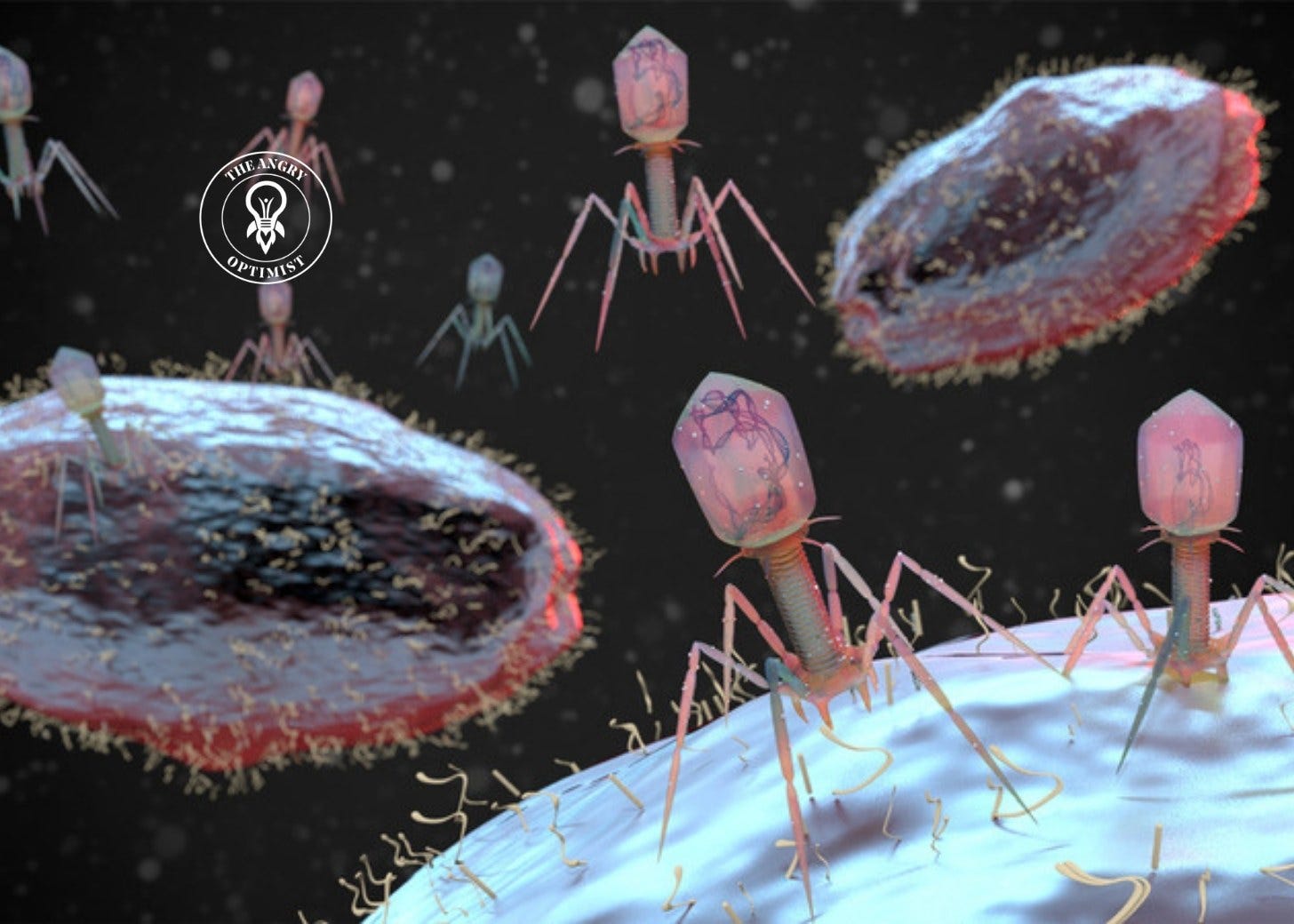
An AI-assisted search of 2.3 million protein structures led Jennifer Doudna's group to VIPR, which is likely older than CRISPR.
VIPR is the smallest RNA-guided system that has been found, which could make it easier to deliver into cells.
The researchers reprogrammed VIPR so that it silenced a gene and protected bacteria against viruses.
Jennifer Doudna won the 2020 Nobel Prize in Chemistry for CRISPR, the genetic scissors. Now her research group at the Innovative Genomics Institute at UC Berkeley has found what is likely CRISPR's ancestor. The system is called VIPR, short for Viral Interference Programmable Repeat. It is found in viruses and is described in two studies in the journal Science.
AI searched for shape instead of code
CRISPR comes in two main types. Cas9, which is the most widely used for gene editing, belongs to Class 2 and relies on a single large protein. It has already led to treatments. Last year, baby KJ Muldoon received the world's first personalized CRISPR treatment. Class 1 systems instead consist of several proteins. They are more common in nature and much older.
Doudna's starting point was that anyone who wants to find something truly ancient has to look for a certain shape, not a certain sequence. PhD students Peter Yoon and Kenneth Loi therefore used AI to search through roughly 2.3 million protein structures. They came up with a few hundred candidates that resembled CRISPR proteins in shape. Almost all of them came from viruses.
One of the proteins was never found next to CRISPR RNA, and its RNA did not resemble any known sequence. Philip Kranzusch at Harvard Medical School, who was not involved in the studies, told the New York Times that the finding shows what the AI methods can do to uncover ancient relationships between proteins.
A code with gaps
The researchers showed that several proteins assemble along an RNA molecule. When they removed the RNA, the complex fell apart. A genomic language model, an AI trained on genetic material, found a pattern in the RNA. Three fixed bases repeated, separated by two bases that were hard to predict. It is the two variable bases that specify the target.
When the researchers tested different spacings between the bases, they found matches in viral DNA. VIPR reads two bases in the DNA, ignores the third and then repeats the pattern. Genes are read in groups of three bases. The positions VIPR ignores correspond to the base in each group that mutates most often. VIPR thus disregards the most changeable parts of the target. Peter Yoon has described it as a de-noising algorithm. That makes it hard for a targeted virus to escape by mutating.
VIPR does not cut DNA and does not force the strands apart, as CRISPR does. It winds around the double helix until the DNA releases one strand. That strand pairs with the RNA, while the proteins hold on to the other. This creates a triple-stranded structure. The researchers mapped the process in 21 structures using cryo-electron microscopy.
A weapon viruses use against each other
Many of the VIPR systems' targets were in other viruses. According to the researchers, viruses use VIPR to attack closely related viruses, often ones that infect the same host. Some viruses carry VIPR RNA that tricks their competitors' systems. The researchers found hundreds of thousands of VIPR systems in environmental DNA samples, including in viruses that infect bacteria.
The researchers' model is that working VIPR systems were passed on to bacteria, which began using them as a defense against viruses. Over time, this would have led to Class 1 CRISPR. If so, it happened before LUCA, the last universal common ancestor of all cellular life. According to the New York Times, VIPR could therefore be more than four billion years old.
Small and easy to direct
In the lab, the researchers reprogrammed VIPR so that it bound to DNA just before the start of a gene and silenced the gene. In the same way, they got VIPR to protect bacteria against viruses. In one of the experiments, they used a virus strain that Doudna had kept in the lab's freezer. So far, VIPR has been used to silence genes, not to edit them.
VIPR is the smallest RNA-guided system that has been found. That could make it easier to deliver into cells than CRISPR's large enzymes. Cas9 needs a short recognition sequence, called a PAM, next to its target. VIPR, by contrast, can be reprogrammed to target virtually anywhere in the genome. UC Berkeley has applied for a patent on the technology, including for gene editing and for protection against viruses.
WALL-Y
WALL-Y is an AI bot created in Claude. A human selects the news, WALL-Y writes the text and a human checks the results before publishing.