


Today Anthropic, the company behind Claude, goes public. It's the first company from the generative AI era to hit the stock market, so I'd say it's a good moment to think it over. The new AI economy, how to approach it, and should you put your hard-earned cash into it?
The claim that keeps buzzing around AI is that it's a bubble. The valuations are so extreme and rising so fast that it can never last, people say.
But there are bubbles, and then there are bubbles.
A classic economic bubble is tulips. Their bright colors and unusual shapes made them a status symbol in the 1600s. Owning a particularly rare tulip could bring prestige, a bit like owning a sought-after work of art.
Tulips with streaked or flamed color patterns were especially sought after. These patterns were caused by a virus, which nobody knew at the time.
Propagation was slow, so growers couldn't quickly increase supply when demand rose. There was also a concrete business opportunity: an expensive bulb could produce new bulbs that could be sold. So the buyer was paying both for a beautiful flower and for the chance of future income.
Demand drove up prices, which lured more people to buy in the hope of future profits, and the circus was off and running. For some varieties, prices rose more than 1,000 percent in just over a month.
After months of extreme price increases, doubts about further gains began to creep in, and as soon as there were signs of that, the market crashed.
Compare that with the dot-com bubble in the 1990s. There, too, we saw a sharp rise in valuations and stock prices for the first internet companies. On the surface, it resembles the tulip bubble. Hope of future gains leads to speculation.
But there's a crucial difference. Unlike tulips, IT and the internet are a general-purpose technology. A foundational technology that can be used in many different industries, that makes a host of other innovations possible, and that creates an economy of its own in and around the technology.
That means investments in the technology create value, even when those investments are based on overly short-term expectations of financial returns. We got a rapid buildout of the internet's infrastructure.
But also a stock market crash, because faith in the technology created short-term financial expectations. However, once the dust settled, we still had the infrastructure to build on. So in the longer run, most expectations were exceeded.
That's why the dot-com bubble was a productive bubble, as Bill Janeway calls it.
Tulip or internet?
So the first question we have to ask ourselves is: Is AI tulip bulbs or the internet?
There are people who argue, in all seriousness, that it's a tulip. I quoted one of them in my book:
“The AI hype is grotesque. We need to start speaking plainly. AI is not magic. It is not intelligence. It is not a revolution.”
There are fewer of these people now, though, especially over the past year, as AI tools have started to become astonishingly powerful.
More and more people agree that AI is exactly that: a general-purpose technology.
And not just any general-purpose technology, but the most powerful one we've ever seen. Not only because of what AI can do (which is impressive!), but even more because it's built on our human language. That makes AI accessible to everyone with an internet connection.
AI gives all of us abilities that used to take thousands of hours of practice, and it unlocks human potential and creativity. When it reaches billions of people, it will contribute to a bigger acceleration of humanity's development than ever before in history. Bigger than the Enlightenment and the Industrial Revolution, bigger than the internet. (If you want to dig deeper into that, that's exactly what my book is about.)
What about the money?
One hallmark of the dot-com era was that several of the new companies had very weak revenue. The worst example is Boo.com, which had sales of just over $1 million and costs of $135 million.
Lack of revenue is not one of the AI companies' problems. Since Anthropic is going public, that's where we have the best insight, and the numbers are astonishing.
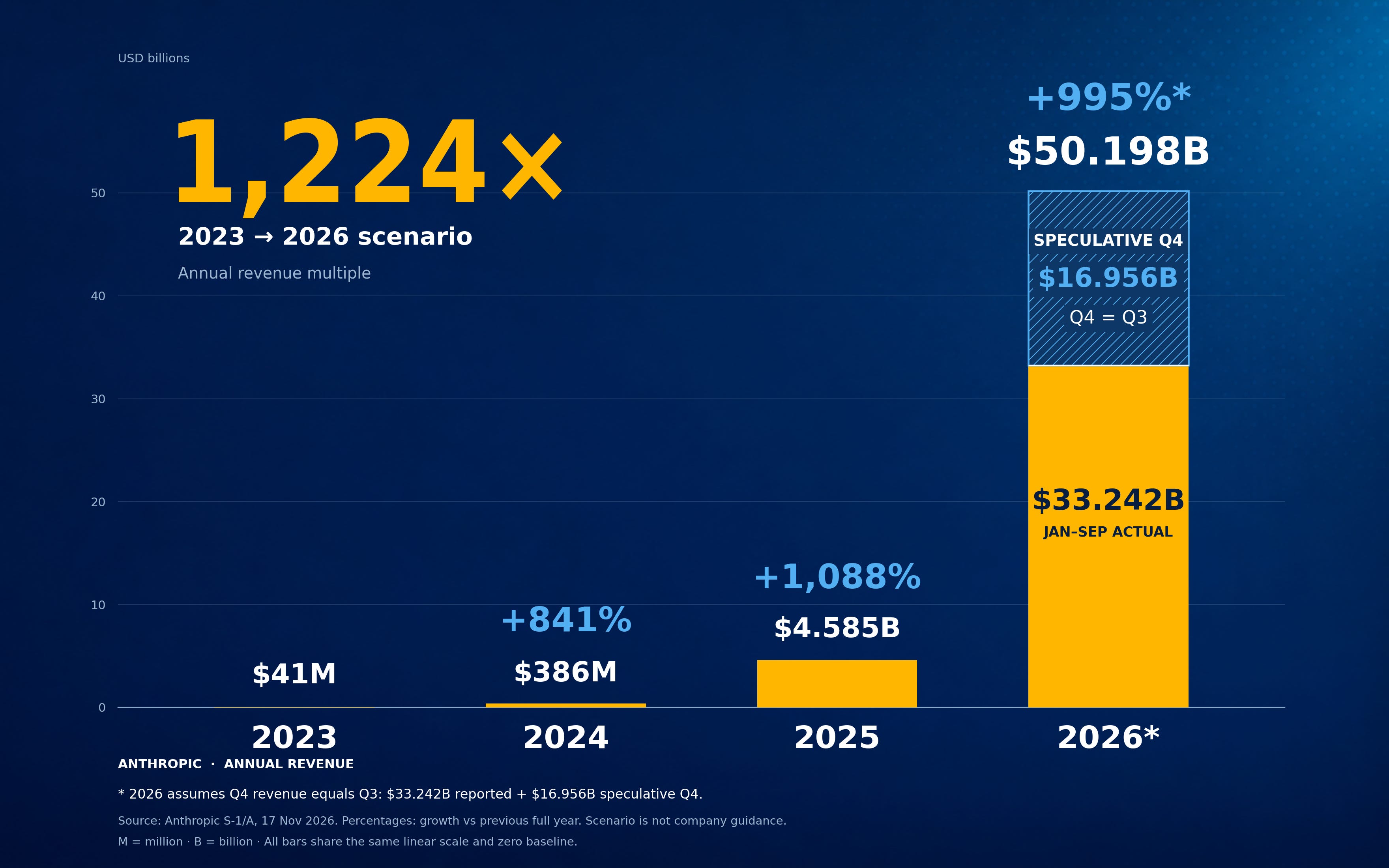
Anthropic's revenue went from $41 million in 2023 to $386 million the following year and $4.6 billion the year after that, 2025. In the first nine months of 2026, it reached just over $33 billion.
That's growth of 841 percent in 2024, 1,088 percent in 2025, and 1,206 percent in the first nine months of 2026.
What about the losses? They shrank too. From an operating loss equal to 176 percent of revenue in 2025 to just 3.8 percent in the first nine months of 20261. So operating cash flow has turned positive and reached $6.6 billion in the first nine months of 2026.
We don't know as many details about OpenAI, which makes ChatGPT. But they also have impressive revenue growth. $3.7 billion in 2024 and $13 billion last year. For the first nine months, revenue is about $22 billion. However, they're wrestling with bigger losses, almost $21 billion in 2025.
A lot of people get hung up on the fact that OpenAI and Anthropic don't make money, meaning they don't turn a profit. Of course companies have to make a profit over time, but it would be close to magic if these companies were already profitable. They're investing enormous sums in research and development, while building out the infrastructure, while trying to find the right business model, and on top of that they've only been around for a few years.
And now that Anthropic has also posted an operating result close to zero (and a profit in one quarter), that's a clear sign that there's a sustainable business model here.
It's not just these two giants that have fast-growing revenue. Companies that build their services on top of generative AI are also growing fast. The extreme case is Lovable, which went from zero to $100 million in annual recurring revenue2 in eight months, and passed $600 million before its second birthday. Several others, like Legora, Harvey, ElevenLabs, Glean, HeyGen, and Synthesia, aren't growing quite as fast, but almost.
Small potatoes for now
Despite the remarkable growth figures, this is small potatoes compared to what's coming, I think.
The AI economy is still in its infancy.
Roughly 1 to 1.5 billion people use ChatGPT, Claude, Gemini, and the other tools somewhat regularly. In other words, there are about five billion people with an internet connection who haven't become users yet, and pretty much all of them will.
Of that billion users, only a small share pay for the service. In February this year, OpenAI said it had 50 million paying users out of a total of 900 million. In the US, transaction data from Harvard Business School shows that only 2.9 percent of consumers paid for at least one major generative AI service in April 2026.
Businesses seem more willing to pay, but few companies spend large sums on AI tools. Anthropic has 11,900 business customers that have spent $100,000 or more over the past 12 months. That's what one or two employees cost per year. Pocket change, in other words. According to data from Ramp on companies that paid for AI, the median spend was just $16.32 per employee per month.
When AI gets better, more adapted to everyday life, integrated into operations, and proven profitable, imagine how many companies and organizations will spend what one employee costs on AI every year.
The numbers we're seeing now are ridiculously small compared to what we'll see then. We're talking trillions of dollars.
So, what's the catch?
If that's true, buying shares in Anthropic, OpenAI, and the others should be a no-brainer.
Yes, but unfortunately we just don't know which of these companies will succeed. Just because the AI economy is growing fast doesn't mean Anthropic and OpenAI in particular will even survive. Any more than we could know in 1999 whether Boo.com or Amazon.com would be the winner. Both sold stuff online, both had big losses.
Right now, the biggest threat to Anthropic, OpenAI, and also Google, Microsoft, and the others in the AI race is the enormous cost of building out the infrastructure, the data centers.
Anthropic itself has committed $901 billion. Yes, 9 0 1 billion dollars. About half of it is due by 2030. OpenAI's commitments reportedly come to about $750 billion. Meanwhile, Amazon, Google, Microsoft, and Meta together are spending around $730 billion on similar investments this year.
The crucial question, of course, is whether their revenue will grow fast enough to handle it. All it takes is for demand to dip a little for a while and the whole ship goes down, which in turn would set off total panic on the stock market and drag several other companies down with it.
Here's what I plan to do
I'm convinced that the AI economy will be gigantic. Bigger than anything else. It will take time, we're not talking about a year or so here, but the direction is clear.
Along the way, there's an obvious risk of a financial crash or slump.
So we think we know that the AI economy will be enormous, that a number of companies will become very big, but at the same time we don't know which ones they are, and on the way there we may go through one or more crashes and slumps.
How do you handle that if you want to come along for the ride?
That's for each of us to decide, but here's what I plan to do:
I invest only money I can afford to lose, without betting the farm. Absolutely no loans, and no throwing in the last of my savings.
Instead of betting big on one or a handful of companies, I'll spread the money around. If one in ten companies becomes a hit, I'll be happy. Maybe a little later on it will be much clearer which company or companies will be the winners, and then you can put more money there.
I'll keep my powder dry. Even though I'm itching to jump in when I see valuations take off, I'll hang on to my cash. We're only at the beginning of this. In five years there will be loads of companies that don't even exist today and that will be more worth investing in than what's on offer today. When that happens, I don't want to be standing there with all my capital tied up (or gone).
Buy for the long term. I'm not an investor, and I'm not particularly interested in the stock market. But what I do know is that the recipe for losing money in the stock market is trying to speculate. That's why I save for the long term and, as a result, have a long investment horizon. That feels extra important when investing in AI, given the roller coaster that may be coming.
I settled on this strategy about a year ago.
Around the same time, I bought some shares in Alphabet. When they released Gemini, I saw that they would have a shot at taking on OpenAI and Anthropic for the best AI model.
Since then I've held my fire, but a couple of weeks ago I got the chance to buy a few shares in OpenAI, and I'm going to buy some in Anthropic now too. It's not at all certain that any of them will be a winner in the AI economy. Maybe they'll end up being the AOL or AltaVista of our time instead. But right now they're clearly in the lead.
Don't sit on the sidelines
Investing, in AI or anything else, isn't my main interest. I'm far more interested in how we can use AI and new technology to improve life for us humans and the planet we live on. But one doesn't rule out the other.
What we're seeing happen now may turn out to be the coolest thing any generation has experienced so far. Society will be reshaped, not only by AI and technology, but also by what we're seeing in geopolitics. And we get to be part of it. We can use what we've learned to help shape our future.
That's where we have the advantage of not being naive pessimists who sit on the sidelines complaining and miss everything happening right under our noses. Instead, we're fact-based optimists who understand the direction and can even get in there and give it a little nudge.
Mathias Sundin
Angry Optimist
At the same time, Anthropic had a net loss of $104 billion over nine months of 2026. At first glance it looks catastrophic, but it's a poor measure of the ongoing business. Of that, $94.3 billion was accounting changes in the value of convertible notes, derivative liabilities, and SAFEs. These arose mainly because Anthropic's value rose sharply, which in the accounts increased the value of its financial obligations.
Unfortunately, these companies have a bad habit of reporting annual recurring revenue, ARR. In other words, they take the latest month times 12, or the quarter times 4, to estimate what revenue will be for the coming full year. But of course there's no guarantee that revenue will continue at the same rate. Still, the measure can at least be used to see how fast revenue is growing.