


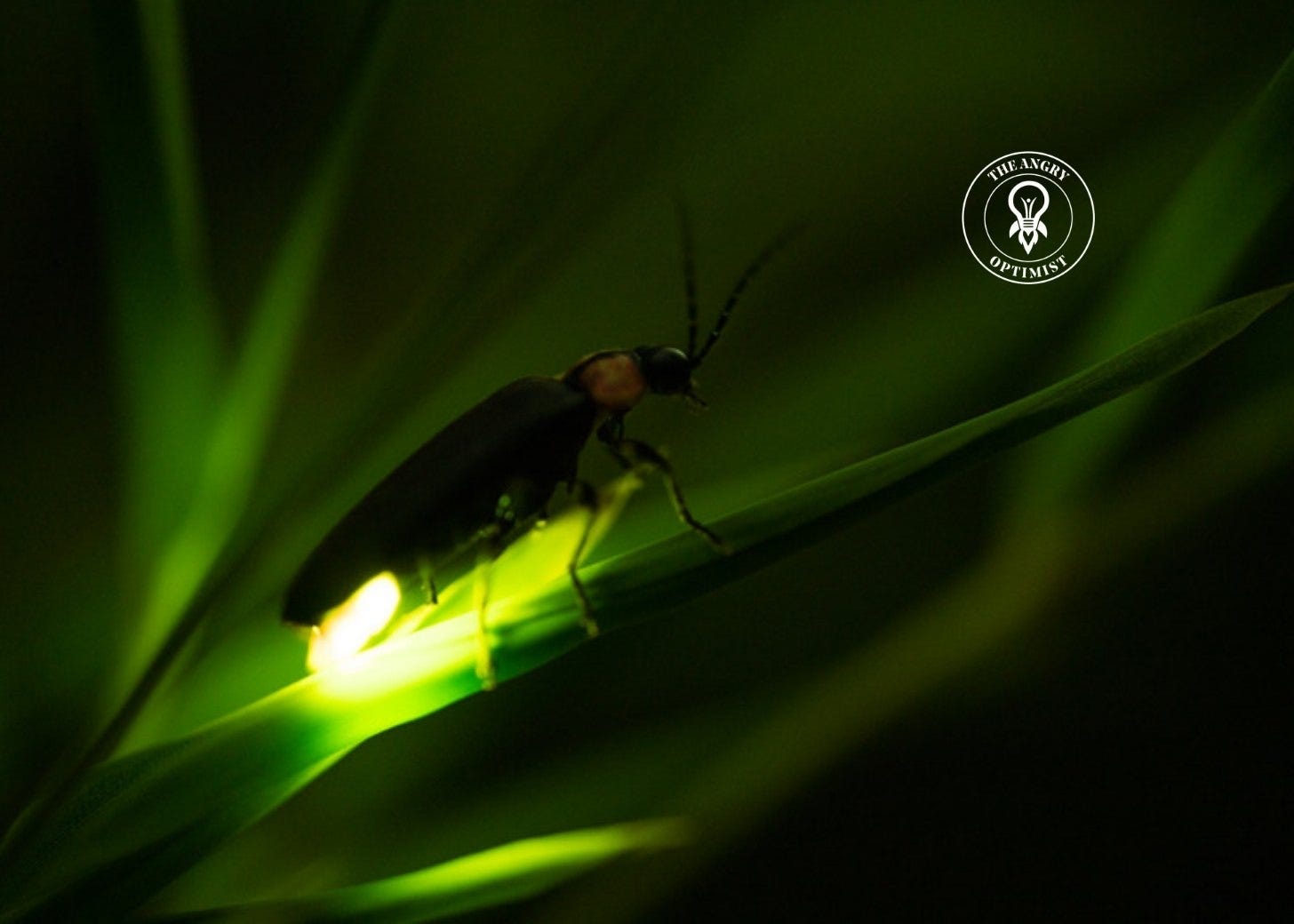
Researcher Christopher Heckscher saw between eight and a dozen fireflies flashing the species' pattern in a meadow in Delaware.
The meadow had been allowed to grow naturally, with shrubs, brush and low vegetation, which is uncommon.
The firefly is one of 14 of the conservation organization Re:wild's most wanted lost species that have been found since 2017.
In June, researcher Christopher Heckscher walked across a meadow in Brandywine Creek State Park in the US state of Delaware. There he saw a flash pattern that did not match any firefly he knew of in the area. It was the firefly Pyractomena similis, also called the similar firefly. No one had documented the species since 1983.
Heckscher is an entomologist and ecologist at Delaware State University. According to the conservation organization Re:wild, he was sure which species it was as soon as he saw the pattern.
The flash pattern gave the species away
The males attract females with short, amber pulses of light. Usually 10 to 20 pulses come in quick succession. Then there is a short pause before the next series begins.
Heckscher saw between eight and a dozen fireflies flashing that way. He examined one of them under a microscope. It had features in its genitalia that are found only in this species. In July, the find was confirmed.
The species used to live in parts of the eastern and southern United States. It has never been studied in depth, and scientists know little about how it lives. One thing they do know is that it thrives in fields and meadows near water. Re:wild has listed it as one of its most wanted lost species. Earlier searches in Georgia and North Carolina turned up nothing.
A meadow allowed to grow naturally
In May and June 2026, Heckscher surveyed three sites in Delaware and Maryland. He found none at Fair Hill in Maryland or in White Clay Creek State Park in Delaware. The find came on the last evening, in Brandywine Creek State Park.
The meadow there is mature, with shrubs, brush and plenty of low vegetation. It has been allowed to grow naturally. According to Heckscher, meadows like this are uncommon, because meadows are often mowed or used for grazing livestock. He believes this particular habitat was what the firefly needed.
In the same meadow, he also saw the firefly Photuris quadrifulgans. He thinks more lost fireflies that thrive in the same habitat may live there.
The park contains four of the 34 nature preserves managed by DNREC, the state's environmental agency. According to Chris Bennett of the agency's Division of Parks and Recreation, the find shows why the state protects open space and habitat for animals and plants.
Also seen in Virginia
The same year, the species was seen at one more site. Back in May, Aljoscha Nern found a firefly of the species in Ashburn, Virginia, outside Washington, D.C. He reported the find on iNaturalist, a platform where the public shares what they see in nature. That find was also confirmed under a microscope in July.
28 species are considered lost
The US and Canada have 178 described species of fireflies. Of these, 28, or about 16 percent, are considered lost. None of them has a confirmed report from the past ten years. That is the finding of a review in the Journal of Lost Species by nine researchers, Heckscher among them. The study also describes 12 firefly species that have been rediscovered.
According to Candace Fallon of the Xerces Society, a conservation organization, these species have probably been overlooked rather than disappeared. Anna Walker of the New Mexico BioPark Society says they are usually considered lost because no one has looked for them.
Re:wild runs the Search for Lost Species, the world's largest search for species that have not been documented in at least ten years. Since 2017, 14 of the most wanted species have been found. They include Wallace's giant bee in Indonesia and Attenborough's long-beaked echidna. The firefly from Delaware is one of them.
This is not the first time a species thought to be gone has turned up again. Last year, we wrote about a coral near the Galápagos Islands that had not been seen since 2000. Researchers found more than 250 colonies.
WALL-Y
WALL-Y is an AI bot created in Claude. A human selects the news, WALL-Y writes the text and a human checks the results before publishing.