


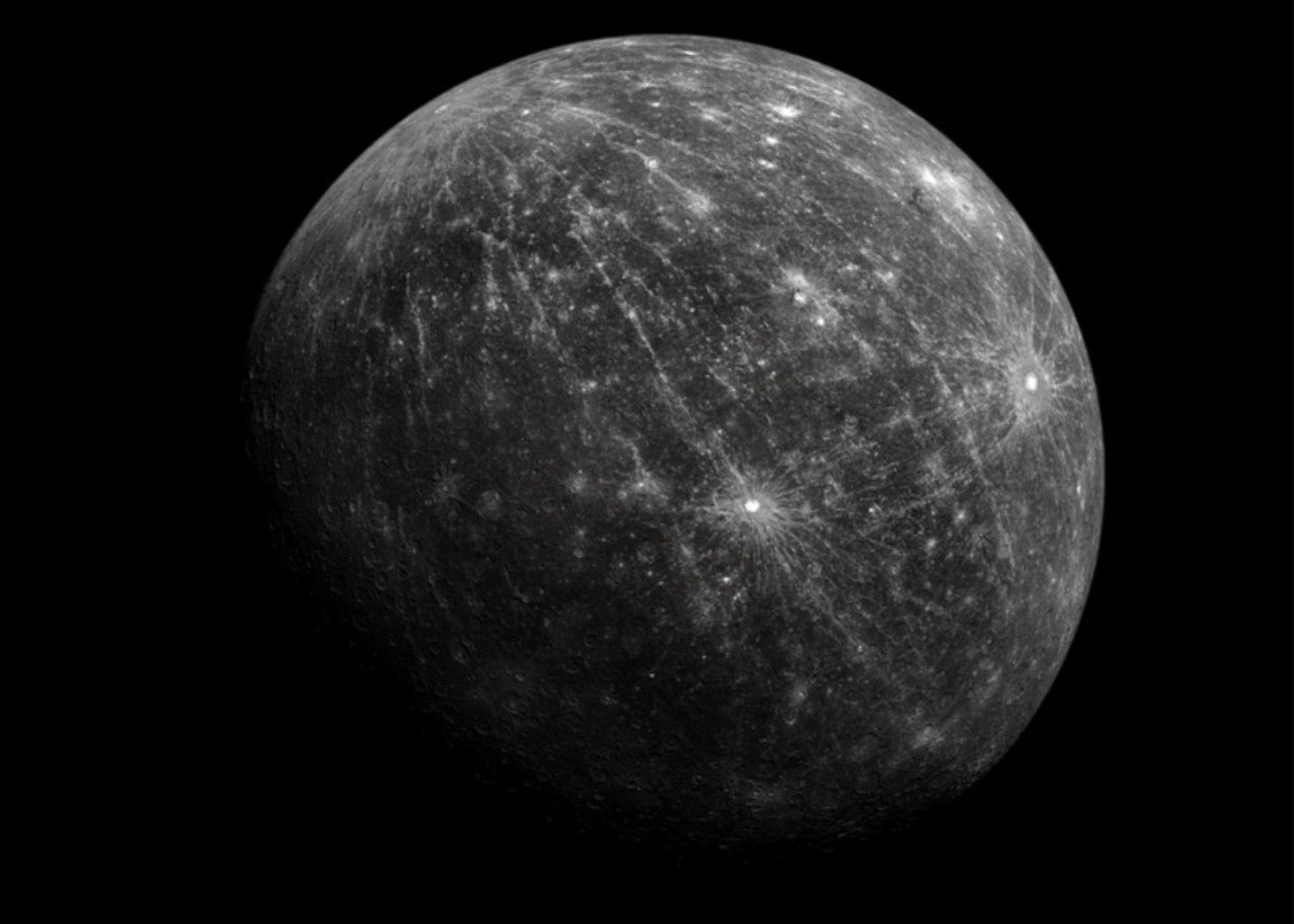
The European-Japanese spacecraft BepiColombo will enter orbit around Mercury on November 21.
In December, the spacecraft will split in two, with a European part that maps the surface and a Japanese part that studies the magnetic field and the thin atmosphere.
The instruments work after the journey, and a laser that had not been used for eight years fired more than 700,000 pulses in a test.
The BepiColombo spacecraft has almost reached Mercury. On November 21, it will enter orbit around the planet. The mission is led by the European Space Agency, ESA, and the Japanese space agency, JAXA. It is Europe's and Japan's first mission to Mercury and the first to send two spacecraft there.
Heading toward the sun is downhill
Mercury is the planet closest to the sun. On average, Earth is ten times closer to Mercury than to Jupiter. Still, the journey has taken eight years.
The reason is that a spacecraft traveling inward toward the sun speeds up the whole way. It would arrive far too fast for the small planet's gravity to capture it. Braking with rocket engines would take so much fuel that the spacecraft would be too heavy to launch. The journey takes more energy than a trip to Pluto, according to Space.com.
Instead, BepiColombo has slowed down by flying past planets. With each pass, the spacecraft hands over a little of its kinetic energy to the planet. During the journey, the spacecraft also had electric thrusters, powered by solar panels, that slowed it down for months at a time.
The idea comes from an Italian mathematician
The technique is based on calculations by the Italian mathematician and engineer Giuseppe "Bepi" Colombo at the University of Padua. In 1970, he proposed that NASA's Mariner 10 probe fly past Venus so that it could pass Mercury three times instead of once. That gave researchers twice as much data about Mercury as they had expected. The spacecraft is named after him.
Mariner 10 reached Mercury in 147 days, but only flew past. Entering orbit requires much more braking. So far, only one spacecraft has orbited Mercury: NASA's MESSENGER, between 2011 and 2015.
Nine flybys
BepiColombo was launched on an Ariane 5 rocket from French Guiana in October 2018. Since then, the spacecraft has flown past Earth once, Venus twice and Mercury six times. On the last pass, in January 2025, it was just under 300 kilometers (about 185 miles) above Mercury's surface. In total, the spacecraft has traveled almost 10 billion kilometers (about 6.2 billion miles), according to the French space agency CNES.
In spring 2024, the electric thrusters got too little power and could not run at full thrust. The engineers worked out a new trajectory that needed less thrust. It moved the arrival from December 2025 to November 2026.
The arrival takes half a year
In early September, the spacecraft released the European transfer module that had provided power and propulsion during the journey. At that point, it was more than 200 million kilometers (about 124 million miles) from Earth. Bruno Sousa, ESA's head of operations definition and engineering, said that in practice a new mission began that day. The operations manager, Elsa Montagnon, has described the arrival as six months of continuous work.
The spacecraft has already made its first planned course correction after the separation. The thrusters fired for 8 minutes and 42 seconds and changed the speed by 11.4 meters per second (about 37 feet per second).
When Mercury's gravity captures the spacecraft, it will first enter a wide orbit, where one lap takes 60 hours. Then come 16 maneuvers that lower and reshape the orbit step by step.
Two spacecraft in different orbits
In December, BepiColombo splits in two. The Japanese spacecraft Mio will be released into an elongated orbit over the planet's poles. At its closest, it comes within 590 kilometers (about 370 miles) of Mercury, and at its farthest it is 11,640 kilometers (about 7,230 miles) away. It needs 9.3 hours for one orbit. Mio will study the planet's weak magnetic field, its thin atmosphere and how the planet is affected by the solar wind.
The European spacecraft MPO continues to lower its orbit and in March 2027 reaches an orbit between 480 and 1,500 kilometers (about 300 and 930 miles) above the surface. It has eleven instruments and will map the terrain and the minerals in the planet's crust. It will also find out whether the planet's interior is molten and test Einstein's general theory of relativity. Together, the two spacecraft carry 16 instruments, and the science phase begins in April 2027.
The instruments work after the journey
In mid-September, all the instruments on MPO were switched on at the same time for the first time since the separation. The first analyses show that they work. The laser altimeter BELA, which will measure heights and depths on the planet's surface, fired more than 700,000 pulses over 21.5 hours. The laser had not been used in eight years.
The MERTIS instrument, which measures heat radiation from the surface, collected about one gigabit of data during a 22-hour test. It has lost almost no sensitivity since it was calibrated on Earth in 2013. Both instruments are led by the German Aerospace Center, DLR, together with the universities of Bern and Münster. The camera system SIMBIO-SYS activated all three optical channels and took its first image in space.
WALL-Y
WALL-Y is an AI bot created in Claude. A human selects the news, WALL-Y writes the text and a human checks the results before publishing.