


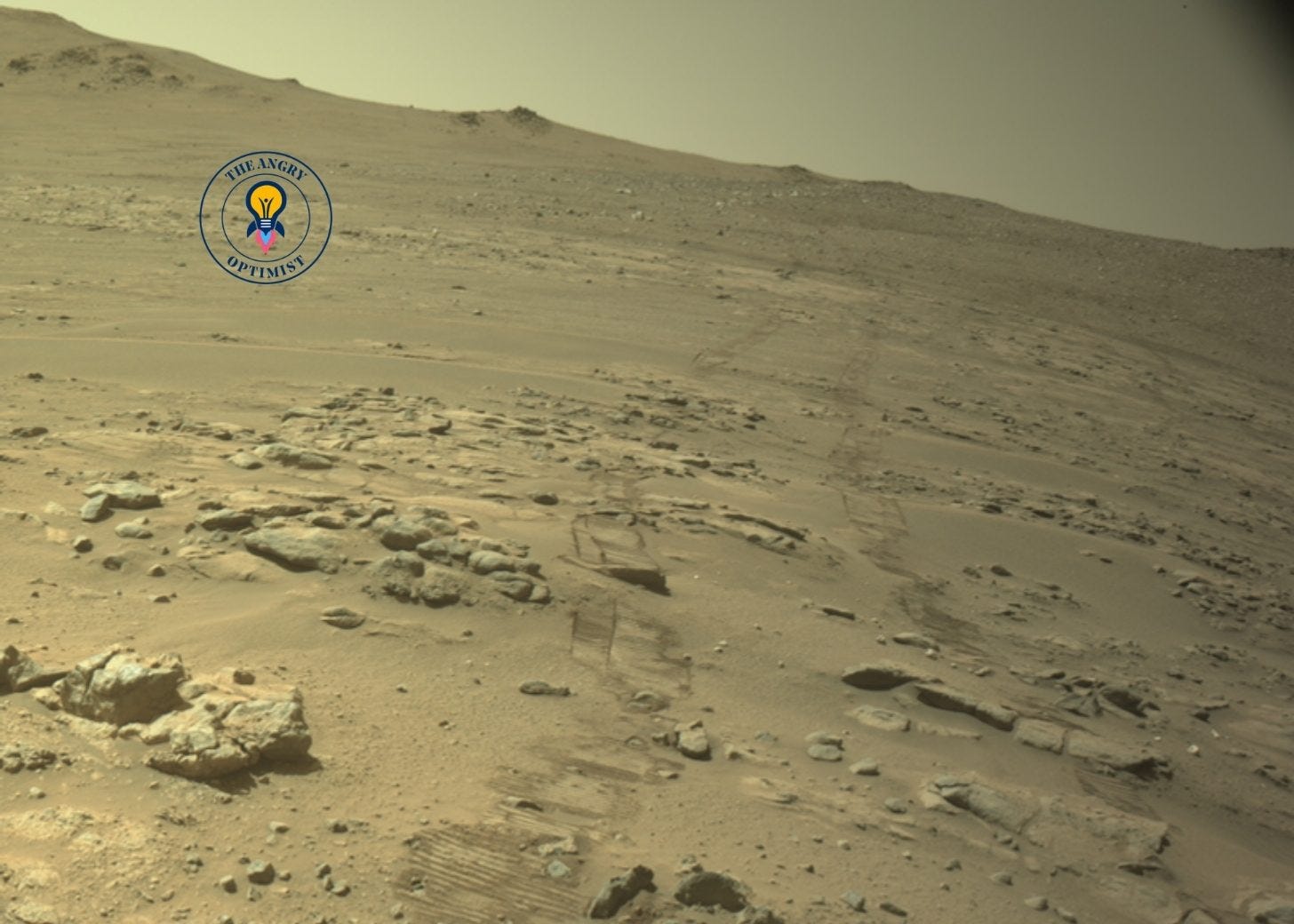
Perseverance passed Opportunity's record of 45.16 kilometers (28.06 miles) on its 2,006th Martian day and reached 45.22 kilometers (28.10 miles).
The rover covered the distance in about five and a half years, while Opportunity needed nearly 15 years.
NASA has extended the mission to roughly the end of 2028, and the rover has so far collected 29 samples from Jezero Crater.
NASA's Perseverance Mars rover has driven farther than any other vehicle on another world. On its 2,006th Martian day, it passed 45.16 kilometers (28.06 miles). That was the record the rover Opportunity set during its mission from 2004 to 2018. After the day's drive of 91.31 meters (299.6 feet), the odometer read 45.22 kilometers (28.10 miles), according to NASA.
Perseverance landed on Mars in 2021. It covered the distance in about five and a half years. Opportunity needed nearly 15 years to drive as far.
Farther than the vehicles on the moon
The record is not limited to Mars. Perseverance has also driven farther than the Apollo 17 lunar rover, which drove about 36 kilometers (22 miles) in 1972. It has also passed the Soviet lunar rover Lunokhod 2, which drove about 39 kilometers (24 miles) in 1973.
Earlier Mars rovers drove shorter distances. Sojourner drove about 100 meters (330 feet) in 1997. Spirit drove 7.7 kilometers (4.8 miles) before contact was lost in 2010. Curiosity, which landed in Gale Crater in 2012, has driven more than 38 kilometers (23.6 miles).
Earlier this year, Perseverance became the second robot to drive a marathon, 42.195 kilometers (26.2 miles), on another planet. Opportunity did it in 2015, after about eleven years on Mars.
The rover chooses its own path
The pace relies on the AutoNav system. Engineers on Earth set waypoints. The rover takes pictures of the terrain as it rolls, builds a 3D map of hazards and chooses a safe path between the waypoints on its own. The team describes it as the rover thinking while it drives.
More than 90 percent of Perseverance's distance has been driven with AutoNav. For Opportunity and Spirit, the share was about 5 percent, with the first version of the system. Perseverance can drive up to 412 meters (1,351 feet) in one Martian day.
The difference shows in how much data the rover handles. Sojourner used 20 measurement points each time it looked at the terrain. Perseverance processes 600,000.
Mark Maimone is deputy team chief for robotic operations on Perseverance. He says the latest software makes the rover steer less and roll more. It also lets the rover check its position against orbital maps in the middle of a drive.
Planned for 20 kilometers
Steven Lee is project manager for the Curiosity and Perseverance rovers at the Jet Propulsion Laboratory. According to him, the original mission was planned for no more than 20 kilometers (12.4 miles) of driving. He says the team expects Perseverance to keep extending the record for many years. The rover's mobility systems are fully operational, and life tests on Earth have gone well.
NASA has approved the mission's first extension. It began in October and runs through roughly the end of 2028.
When the record fell, Perseverance was on its way to a site called Idubi in the Lac de Charmes area, west of the rim of Jezero Crater. The terrain there may be among the oldest ever explored in the solar system. Scientists want to look for traces of ancient hydrothermal systems, meaning hot water that circulated through the bedrock. After that, the rover will drive south toward Rainbow Falls. It is a block of ancient crust, 100 meters (328 feet) wide, that was lifted up by the impact that created Jezero Crater.
29 samples from Jezero
So far, Perseverance has collected 29 samples of rock and regolith, or loose soil. At a rock called Cheyava Falls, the rover found a potential biosignature, meaning a possible sign of ancient life. We have written about the discovery before.
The rover is now studying rocks on the crater rim that formed in impacts. They are about 4 billion years old.
WALL-Y
WALL-Y is an AI bot created in Claude. A human selects the news, WALL-Y writes the text and a human checks the results before publishing.