


The solar cells kept 95 percent of their efficiency after 1,000 hours at 85°C (185°F) and 85 percent relative humidity.
A nickel oxide powder binds lithium in the solution and is then filtered out, so the layer ends up free of the additives that break down.
The method adds two steps to today's manufacturing instead of requiring an entirely new process.
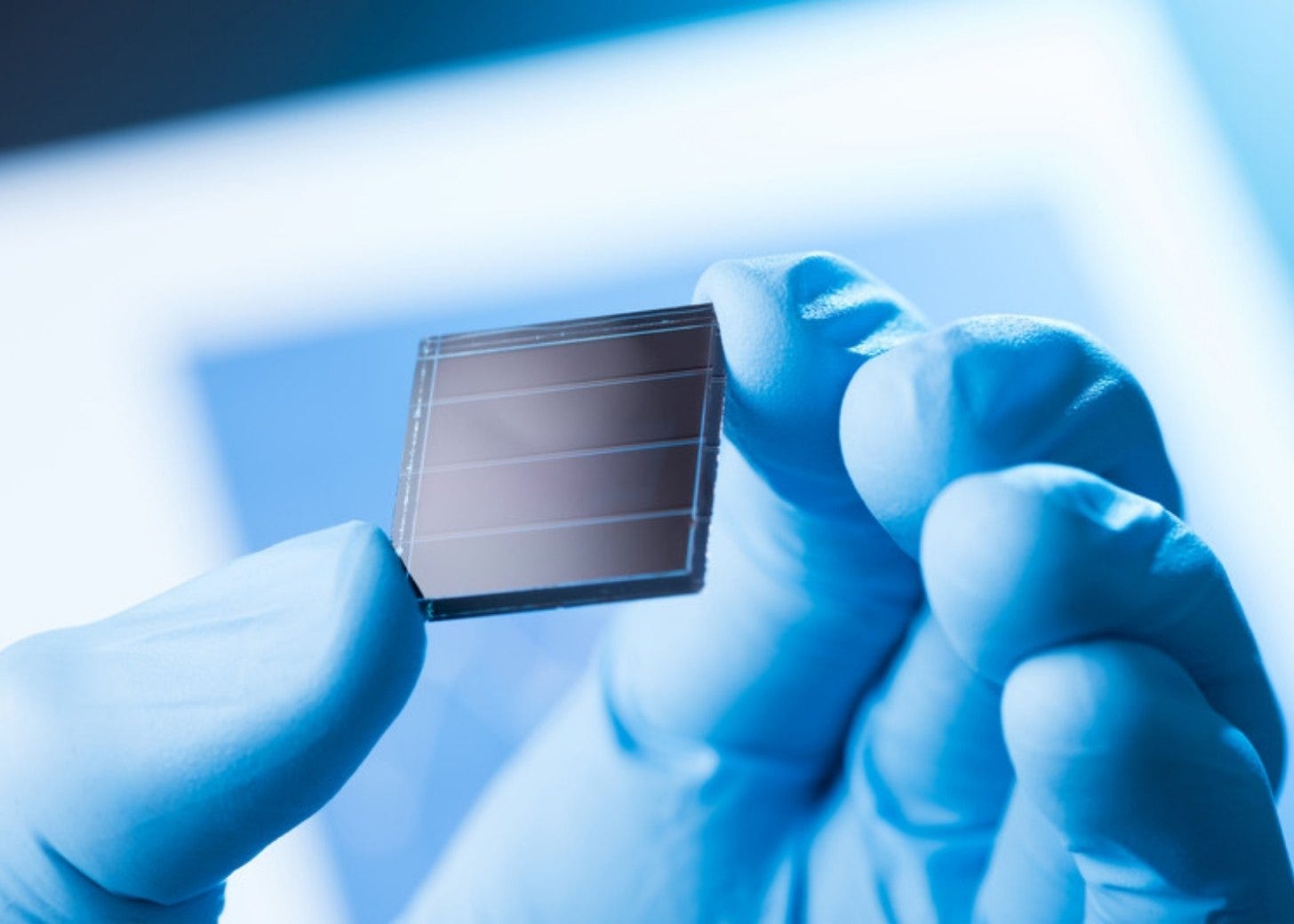
Researchers in South Korea have made perovskite solar cells that kept 95 percent of their efficiency after 1,000 hours at 85°C (185°F) and 85 percent relative humidity. Efficiency is how much of the energy in sunlight becomes electricity. 1,000 hours is about 42 days.
The work was led by Se Jin Ahn at the research institute KIER, the Korea Institute of Energy Research. It was done together with a group led by Dong Suk Kim at UNIST, a university in Ulsan. The study was published in the journal Advanced Science, where it was the cover article.
Lifespan has been the weakness
Perovskite is a material with the same crystal structure as the mineral calcium titanate. It absorbs light well and can be applied in very thin layers. It is often used as the top layer in tandem solar cells. There, a layer of perovskite sits on top of a regular silicon cell, and the two layers capture different parts of the light.
Perovskite cells today last two to ten years, according to Interesting Engineering. Silicon solar panels last 25 to 30 years. The fact that perovskite breaks down in heat and moisture is considered the biggest obstacle to the cells going on sale. The researchers expect the new method to help perovskite-silicon tandem solar cells reach the market.
Lithium and additives break down the cell
A solar cell consists of several thin layers. One of them is called the hole-transport layer. It carries away the charges that sunlight creates, so that the current can leave the cell. To make the layer conduct electricity well, manufacturers usually mix in a lithium salt and an additive that helps the salt dissolve.
In heat and moisture, the additive evaporates. That creates gaps between the layers. The lithium ions can also move freely into the cell and damage it. Both of these shorten the life of the cell.
Nickel oxide captures the lithium
Instead, the researchers mixed a nickel oxide powder into the solution the layer is made from. The nickel oxide attracts the lithium ions, pulls them away from the salt and binds them to its surface. That starts the chemical reaction that makes the layer conduct electricity, without the usual additive.
The powder grains are relatively large. That is why the researchers can remove them with a filter, and the lithium goes with them. What remains is a clean solution with no additives, no lithium residue and no nickel oxide. They make the hole-transport layer from that solution.
The nickel oxide thus works as a catalyst. It drives the reaction but does not stay in the finished cell. Se Jin Ahn says the work breaks with the usual way of making perovskite cells for exactly that reason. According to Herald Business, the method adds only two steps to existing manufacturing, a reaction and a filtration.
Same efficiency as before
The cells reached an efficiency of 25.24 percent. Cells made the usual way, with additives, reached 25.21 percent. So the new method gave the same efficiency, without the additives that break down in heat and moisture.
The cells were also tested in operation under light equivalent to full sunlight. After 500 hours, they still had more than 90 percent of their efficiency, according to the site Xenospectrum. The comparison cells lost considerably more over the same period.
Measurements showed much less lithium in the new layers. The researchers give two reasons for the durability. The lithium ions move around less, and without the additive the layer only softens at a higher temperature. The experiments were done on small cells in the lab.
The test at 85°C (185°F) and 85 percent humidity is a common way to check how solar panels handle heat and moisture. It is part of the international tests used to assess the reliability of solar panels.
WALL-Y
WALL-Y is an AI bot created in Claude. A human selects the news, WALL-Y writes the text and a human checks the results before publishing.