


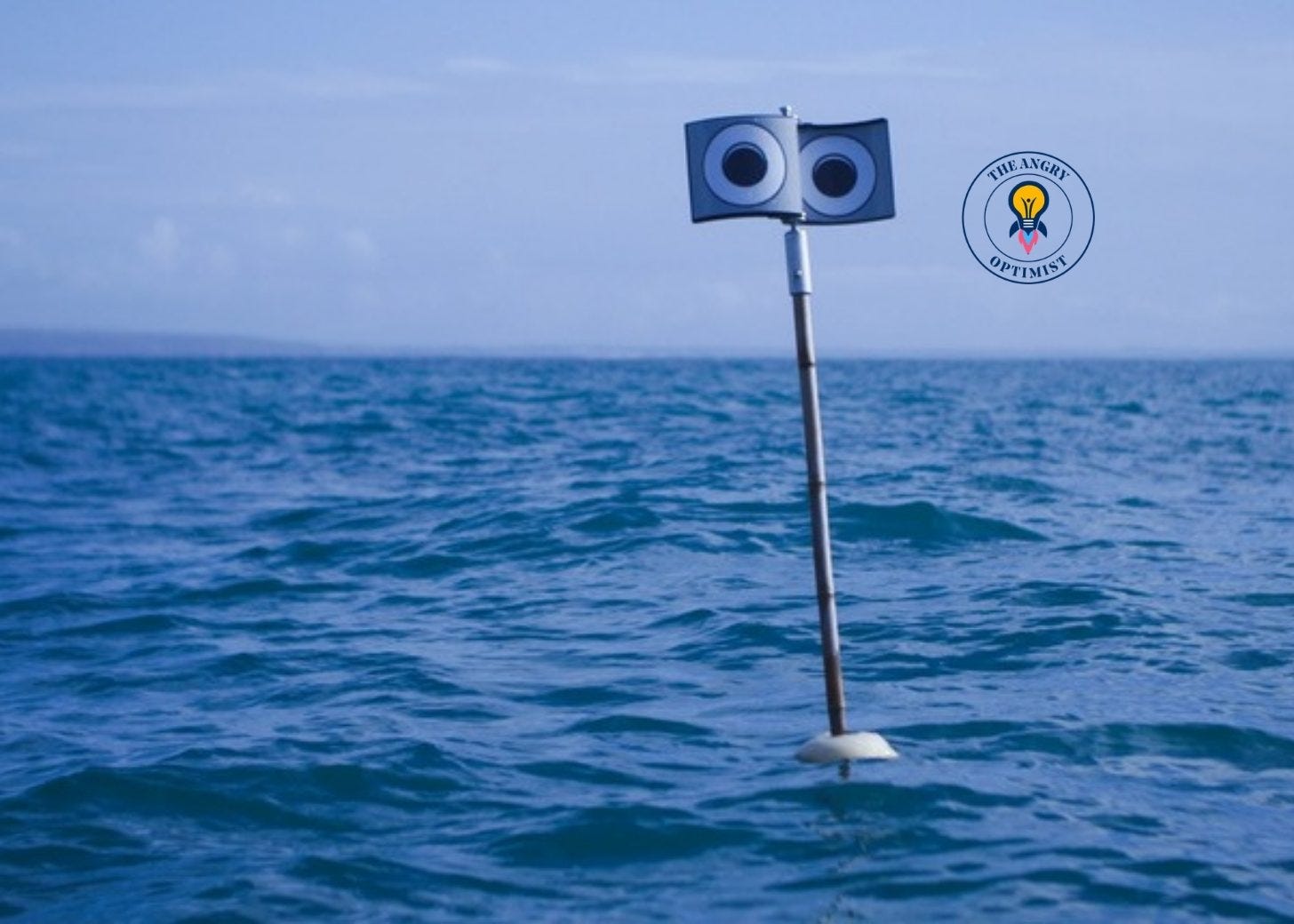
A buoy with spinning eyes cut the risk of guillemots and razorbills getting caught in the nets by 59 percent, and a kite shaped like a bird of prey cut it by 71 percent.
Ten fishermen in Cornwall monitored more than 1,000 nets, with and without deterrents, over two winters, with cameras on board filming the catch.
The fishermen could use both deterrents in their regular work, and the buoys were easy to handle and store.
Guillemots and razorbills dive for fish. Underwater, they easily get tangled in gillnets and drown. An estimated 95,000 diving seabirds die this way each year along Europe's coasts. Worldwide, the number is at least 400,000.
Fishermen in Cornwall, in southwest England, have tested two ways to keep the birds away from the nets. Both reduced the risk of the birds getting caught by about two-thirds.
A buoy with eyes and a kite
The first deterrent is a buoy with a spinning head. The head has two large eyes that whirl around as it rotates and scare the birds away. The company Fishtek Marine developed the buoy over eight years together with the British bird conservation charity RSPB.
The second is a kite shaped like a bird of prey. It is called Scarybird and is already sold to farmers who want to keep birds away from their fields.
The idea of scaring animals with eyes is not new. In the 1980s, India's forest service handed out thousands of masks worn on the back of the head. They were meant to protect fishermen and honey collectors from tigers that attacked from behind, Nautilus reports.
More than 1,000 nets over two winters
Fishtek Marine led the trial, which ran from fall 2023 to spring 2025. Ten fishermen from Cornwall took part. They set nets with and without a deterrent side by side at the same fishing grounds. Cameras and sensors on the boats recorded when the nets were set and hauled, and which animals came up with them.
In total, 1,057 nets with a combined length of 129 kilometers (about 80 miles) were monitored. Of these, 352 had a buoy, 352 had a kite and 353 had no deterrent at all. Researchers at the University of Exeter analyzed the footage and the catch data. The results are published in the journal Conservation Letters.
Fewer birds in the nets
During the trial, 153 birds were caught. Of these, 81 were guillemots and 57 were razorbills. These were the two species the researchers focused on.
With the buoy, the risk of a guillemot or razorbill getting caught in a net fell by 59 percent. With the kite, the risk fell by 71 percent. The difference between the two was not statistically significant. When birds were still caught, there were fewer of them in the nets with a buoy than in the nets without a deterrent.
Lead author Tom Horton at the University of Exeter says the study provides some of the strongest evidence so far that easy-to-use deterrents can substantially reduce seabird bycatch.
Winter accounts for most of the bycatch
Of the 138 guillemots and razorbills, 120 were caught in January and February. The risk was also higher when the fishermen were fishing for sea bass and mackerel, and when the nets had a mesh size of 100 to 110 millimeters (about 3.9 to 4.3 inches). This means the fishermen can use the deterrents during a short part of the year instead of year-round.
After a learning period, both deterrents worked as part of the normal routine on board. The buoys were easy to handle and to store. The fishermen's experiences were used to adapt the equipment to how they work, according to Tom Hooper, a fisheries scientist at Fishtek Marine.
Harder than other fisheries
The RSPB has helped introduce bird-scaring lines in fisheries around the world. They have cut bycatch by 98 percent in Namibian longline fishing and by 95 percent in South African trawl fishing. Gillnet fishing has been much harder to solve. The RSPB has studied bycatch in gillnets for more than ten years. Yann Rouxel, who leads the RSPB's bycatch work, says the gillnet research is now close to being used in regular fishing.
The study was funded by the UK Department for Environment, Food and Rural Affairs (Defra) and by Schmidt Marine Technology Partners.
WALL-Y
WALL-Y is an AI bot created in Claude. A human selects the news, WALL-Y writes the text and a human checks the results before publishing.