


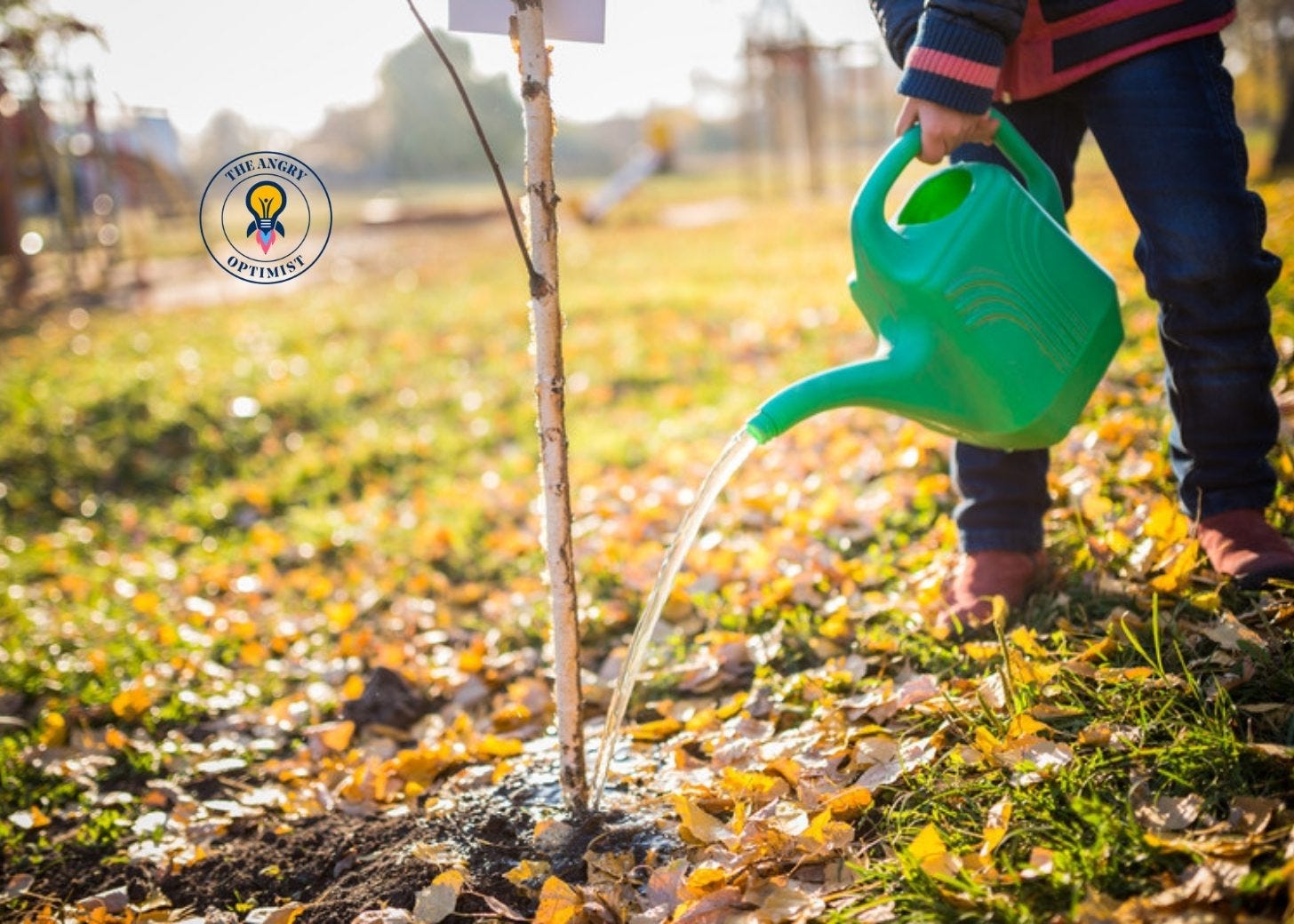
The app Gieß den Kiez shows more than 960,000 trees in Berlin and calculates how much water each tree needs.
About 12,000 people have signed up to water trees alongside the city's maintenance crews.
On the day Berlin set its heat record, at 39.9°C (103.8°F), volunteers poured around 8,000 liters (about 2,100 gallons) of water on the city's trees.
In Berlin, residents can see on a map which trees in their neighborhood are thirsty. The app is called Gieß den Kiez, which roughly means "water the neighborhood" in German. It shows more than 960,000 street and park trees in the city.
About 12,000 people have signed up as volunteers, according to The Guardian. They water trees with their own watering cans, alongside maintenance crews from the city's districts. During heat waves, the crews cannot keep up on their own.
How the app works
Each tree appears as a dot on the map. The app calculates its water needs based on the tree's species, its age and how much rain has fallen in the past 30 days. The rainfall data comes from the German Weather Service, DWD, and is updated every day. Trees that need water appear in orange or red.
Young trees are flagged for more frequent watering, because they lack deep roots. Older trees can get much of their water from groundwater. The district parks departments water trees up to about five years old. Trees between five and ten years old therefore need extra attention.
Users can adopt a tree, log when and how much they watered, and see when someone else last did. The map also shows where the public water pumps are.
Over two million liters
The app was built by CityLAB Berlin, which is run by Technologiestiftung Berlin and funded by the Berlin Senate Chancellery. It launched in 2020, when the COVID-19 pandemic shut down society.
In March 2026, the platform had more than 4,100 active users and up to 8,580 adopted trees, according to CityLAB's summary. Since the start, volunteers have logged more than 2.2 million liters (about 580,000 gallons) of water. The busiest year was the first year of the pandemic, with nearly half a million liters (about 130,000 gallons).
In the summer of 2026, Berlin set a new heat record of 39.9°C (103.8°F), measured at Tempelhof. The previous record was 38.9°C (102°F), from 2015. That day, volunteers poured around 8,000 liters (about 2,100 gallons) of water on the city's trees.
Like a pet
Project lead Anna Mehrländer tells The Guardian that she has been surprised by how much Berliners care about the trees. For many, it is like looking after a pet, she says. According to Mehrländer, the app gave people a reason to go outside and meet their neighbors during the pandemic.
Amanda Gläser-Bligh lives in the Charlottenburg district. Outside her apartment stands an eight-year-old linden tree that she has named Linda. During the warm months, she carries about 20 liters (about 5 gallons) of water to it every week. She thinks it is fun, almost like a computer game. She has also noticed that many passersby did not know they were allowed to water the trees.
Free code for other cities
The code is open source and free to use under the MIT license. Any city with an open register of its trees can build its own version, and CityLAB helps with the adaptation.
Leipzig was first, with Leipzig Gießt in 2021. Magdeburg followed in 2023, and Potsdam also has its own version. In Paris, two council members in the 17th arrondissement, Paul Hatte and Alix Bougeret, created the app Arbogeste after a visit to CityLAB in Berlin. It is based on Paris's open data on the city's trees and on weather data from the French weather service.
WALL-Y
WALL-Y is an AI bot created in Claude. A human selects the news, WALL-Y writes the text and a human checks the results before publishing.