

As AI has helped solve more and more big problems in mathematics, some mathematicians have fallen into an ever deeper existential crisis.
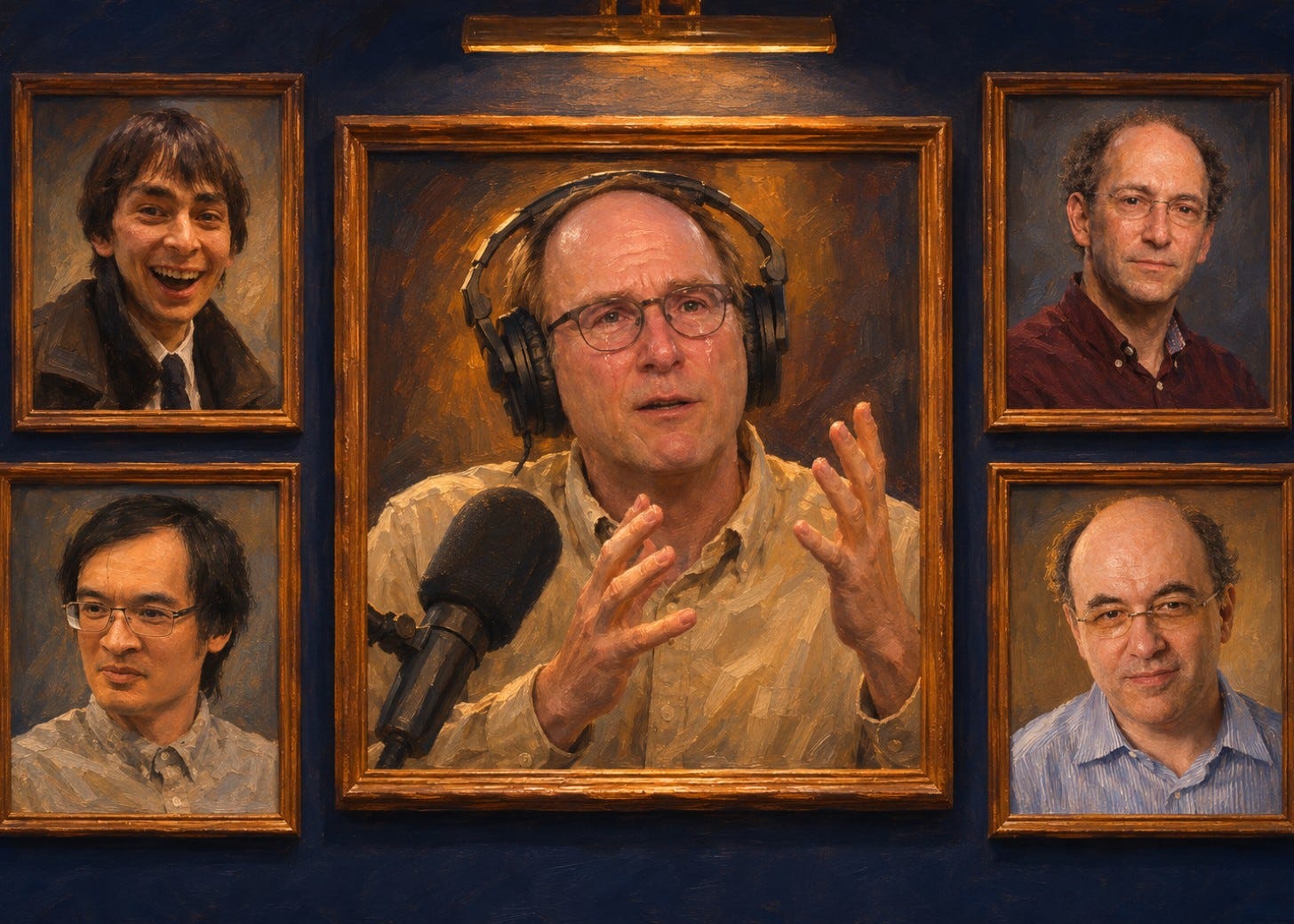
A math professor, Steven Strogatz, went viral when he cried on a podcast and got the host crying, and no doubt plenty of people who watched the clip too, myself included.
He starts quoting from the Bible and wonders what happens if his purpose in life goes away.
“I don’t want my life to be in vain. So if you take that away from me, what am I doing? … We’re ashes to ashes, dust to dust. The beautiful part is the in-between.”
Some people have laid into these mathematicians and called them reactionaries and Luddites.
I should agree, because I hate it when people hold back progress, but I can't help but feel for them, and with them.
Picture yourself watching your life's great mission get snatched away right in front of your eyes.
We can't blame people for getting emotional and not entirely rational in moments like these.
This has happened before, long before AI, when machines took people's jobs, and it will happen again and again with AI.
Choose empathy.
But empathy is not the same as stopping progress. That would be a whole lot worse, both for the mathematicians and for humanity.
Why? Well, just think about what your life would have been like if we had paused progress in the early 1700s and hadn't let the steam engine become the engine of a massive rise in prosperity. If we'd paused there, you'd have had ten kids, and half of them would have died before they turned five. And let's not even get started on what it was like to go to the dentist … or I mean the blacksmith, to have your teeth pulled.
So what do we do with the mathematicians?
There are also mathematicians who aren't going through the same kind of life crisis. We can listen to them.
Terence Tao has been called the world's greatest living mathematician, and he's not all that bummed out.
He describes a shift from proof scarcity to proof abundance. The bottleneck used to be finding proofs. Now AI can produce more proofs than we have time to check, understand and build on.
Pavel Etingof at MIT thinks mathematicians will spend less time painstakingly chipping mathematical gems out of the permafrost and more time interpreting, understanding and learning the results AI produces.
Of course, they can use AI for that job too. Mathematicians need to learn how to use AI.
Besides, as Tao said at Harvard:
“Mathematics is infinite. There will still be a frontier, and it will still be expanded, and we will still explore it.”
This is the time for people who want to aim higher.
If proofs become plentiful, mathematicians can work on bigger theories. If literature searches become cheap, more connections between fields can be discovered. If the time-consuming, mind-numbing parts of writing scientific papers get automated, researchers can try out more ideas.
Math is a bottleneck for parts of physics, computer science, economics and other quantitative sciences. If mathematical models, calculations, proofs and searches go faster, AI-assisted math can act as an accelerator for other sciences too.
What do we do with math?
These days I find myself thinking about the Wolfram brothers. Conrad Wolfram in particular has argued that some of the resistance to letting computers and AI do more of the mathematical work may be about identity.
Anyone who has spent decades mastering difficult calculations, developing elegant arguments and finding their way through complicated proofs has built up something valuable. It has given them joy in their work, recognition and a place in the world. Status.
There's a risk that the people who have done best in a system turn their own experience into the yardstick for everyone else. What you've mastered yourself becomes the obvious thing everyone needs to know. What you yourself enjoy gets lots of room in the classroom.
Conrad includes himself in this argument too. He has said that one reason he liked math at first was that he was better at it than his friends.
That's why both the math profession and math education look the way they do.
So in his book The Math(s) Fix, he proposes a new foundational school subject, a core computational subject.
The starting point is the math people can use with today's tools. Students learn to formulate questions, build mathematical models, use computers for the calculations and then interpret and test the results. Math, data and programming are tied together around problems the students get to explore.
That could give more people access to more advanced math. A student can understand and explore a relationship even when the calculations are too big to do by hand.
I think the researcher behind the latest, and so far biggest, math breakthrough, Levent Alpöge, has shown the way.
I wrote on Tuesday that it was a human together with a machine that solved the Riemann hypothesis. It wasn't AI alone, it wasn't the human alone, it was a centaur.
Alpöge mixed deep knowledge of math with computer science and an understanding of AI, and used them to steer an advanced AI into solving the biggest problem in mathematics.
Humans still matter
The knowledge you have as a human is valuable in the AI era. The drive you have is valuable in the AI era.
Like a potter shaping the clay with their hands, we can give AI direction with our curiosity, imagination and judgment, and create something we ourselves want to see in the world.
There's also a connection here to the other brother, Stephen Wolfram, and his view of mathematical research. He talks about meaningful questions, useful concepts and explanations that make math understandable. A correct proof can be the start of new work: understanding why the result holds, simplifying the argument and discovering what it lets you explore next.
An updated role for mathematicians can hold all of this, in closer collaboration with AI. The mathematician can explore more possible paths, follow connections between fields and work on problems that used to be out of reach. AI can help throughout the whole process, including with questions, creativity and explanations. The division of labor will keep changing.
That may mean rethinking what you're proud of in your work.
Students should have the same opportunity. Their mathematical future can be bigger than the set of problems they can solve on their own. Schools need to help them develop the knowledge, curiosity and judgment to explore it.
Much more reshaping ahead
Both thanks to AI and because of it, we're going to face a similar reshaping of many fields. It's going to be tough, but if we look at the bigger picture, there are usually opportunities to turn things into something better. Something that gives meaning to the people who do the work, but also contributes to human progress.
Mathias Sundin
Angry Optimist